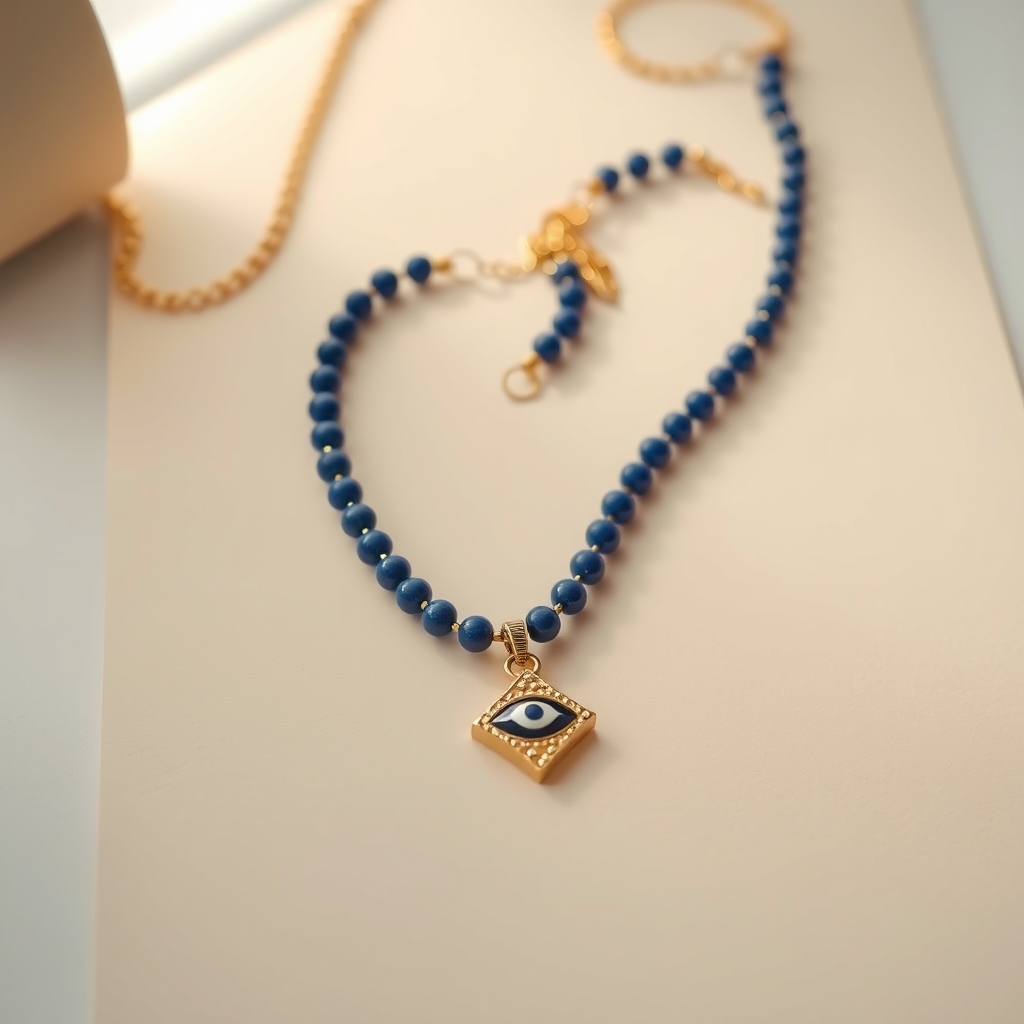

Cobalt blue, white, light blue and a black dot at the centre. You have seen it on doors in Istanbul, on the rear-view mirrors of Athens taxis, on baby bracelets in Guadalajara and on your grandmother's wrist. The evil eye — nazar, in Turkish — is one of the oldest decorative motifs of the Mediterranean and, in recent years, also one of the most present in everyday jewellery. This is its story and a guide to wearing it with style.
Three thousand years of blue glass
The earliest eye-shaped glass beads have been found in Anatolia and date back about three thousand years. They also appear in classical Greece, in Egypt and across the eastern Mediterranean, always tied to the same folk idea: an eye that returns the gaze. Beyond the belief, what has survived is the object: a piece of glass in concentric colours, simple and instantly recognisable.
Workshops in Izmir and Kemalpaşa still blow these eyes by hand in wood-fired furnaces, in techniques passed from parents to children. The blue glass is melted, gathered on a rod, flattened, and the white, light blue and central black are added drop by drop. Every eye has bubbles and irregularities, and that is the mark of the handmade.
Why blue
In the ancient Mediterranean, blue pigment was scarce and expensive; it came from cobalt and lapis lazuli. A blue eye was also rare among dark-eyed populations, and rarity draws attention. Today cobalt blue remains the classic version, but variants exist: light blue, green, white and even red. In jewellery, cobalt is the one that pairs equally well with gold and silver.
From glass to enamel
The blown-glass eye is perfect for hanging on a door or in a car, but fragile on a wrist or an ear. That is why, in pieces that are worn, we use glazed enamel over 18k gold-plated brass or over stainless steel: the same drawing, with the resilience of metal. The enamel is applied layer by layer and fired; the result is an eye with a smooth surface that does not break on impact and does not scratch with wear.
Evil eye and hamsa
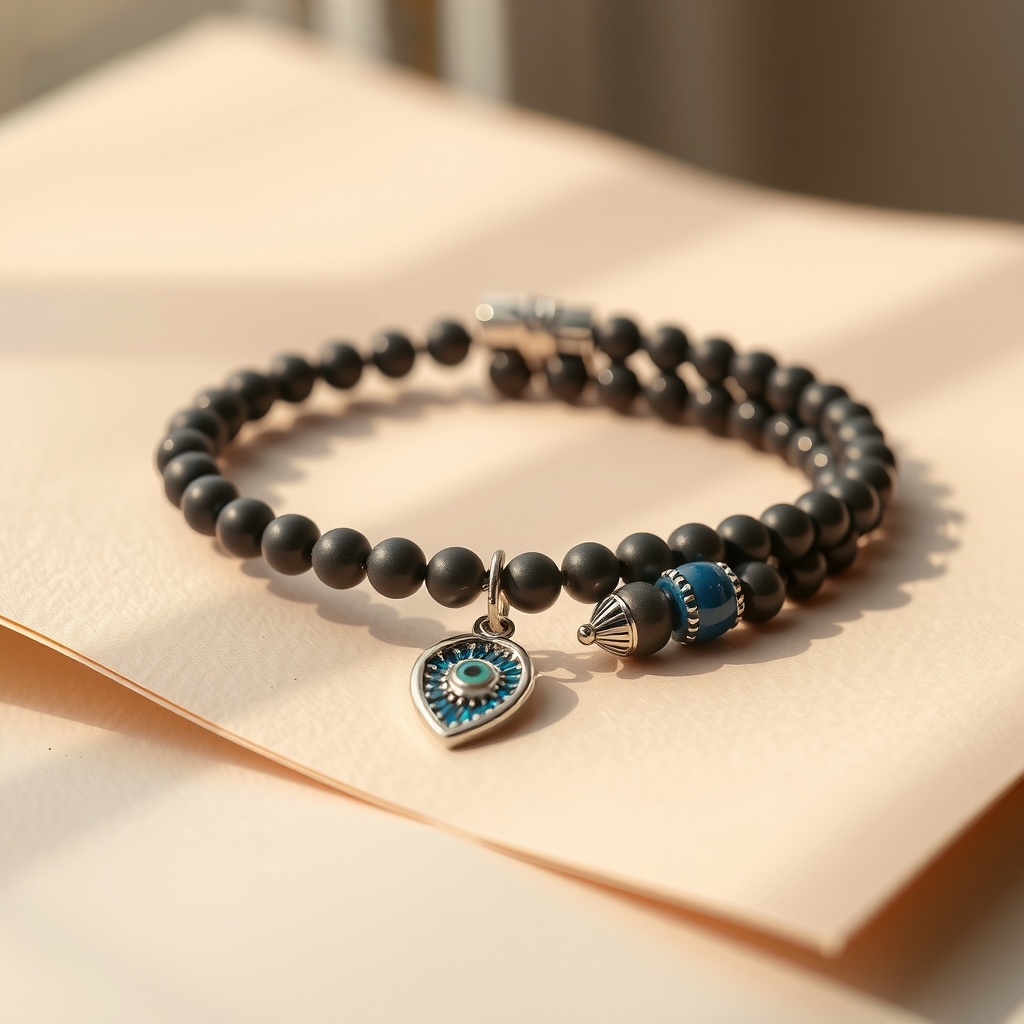
They are cousins. The hamsa is the open five-fingered hand found in traditions across North Africa and the Middle East, almost always carrying an eye engraved in its palm. In jewellery they live well together: our Serene Guardian earring pair combines an onyx stud with a mini hamsa, and several black beaded bracelets carry a glass eye as their only point of colour.
How to wear it today
- On small hoops, hanging from a gold huggie: the most modern form and the one our customers repeat most. Put them on and forget them.
- On red cord, with a sliding knot: the classic. Worn alone or as the base of a stack, and unisex; the men's version carries black enamel and hematite.
- On a short necklace, over a white tee or an open shirt, with a couple of lapis lazuli beads that echo the blue.
- On a signet ring, on the pinky, for anyone who prefers a single detail with character.
- At home, in 8 cm blown glass, by the door or in a window. It is the most common housewarming gift in the Mediterranean.
So it never looks like a souvenir
One eye per look, small (6 to 10 mm) and in a metal repeated in another piece. If you wear it in your ears, do not also wear it on your wrist. Pair it with navy, white and beige, which make the cobalt stand out, or with all black, where it works as the only point of colour. And choose pieces with the eye well centred and the enamel smooth: in the small details you can tell a market trinket from a jewel.